
Horse cart. Paris
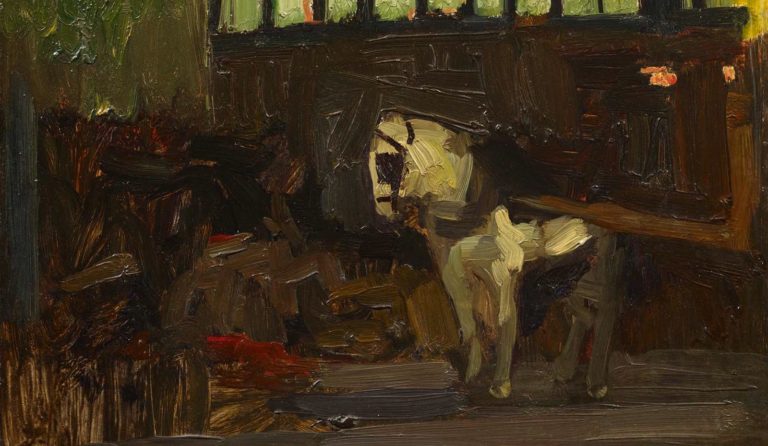
Night scene, centered on a white horse with a cart inside a warehouse in one of the Paris markets. It is an oil sketch that the painter took live from nature and that he later used for larger compositions to present in exhibitions or competitions. A frequent theme in the painting of the first Parisian […]
Read moreLes hortènsies de la sabatera [The cobbler’s hydrangeas]
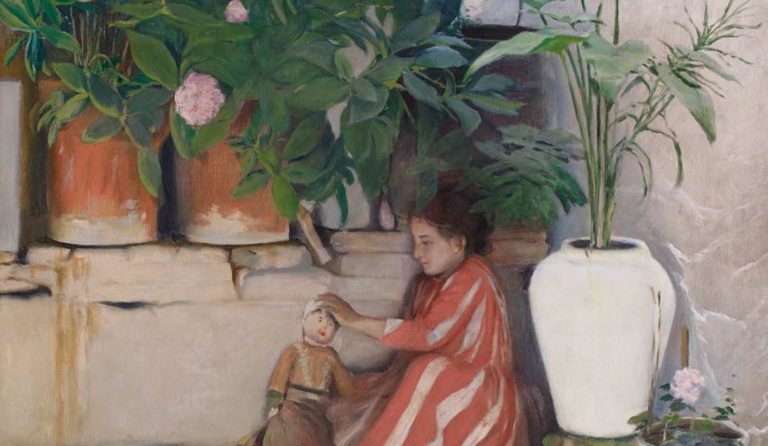
We know Rusiñol’s desire to represent a closed compositional space. In this painting that was presented at a Paris Salon, he paints a corner of a courtyard where he places a girl playing with a doll next to a wall on which there are pots of long-stemmed hydrangeas that cover the entire wall , with […]
Read morePulvis, cineris, nihil [Dust, ashes, nothing]
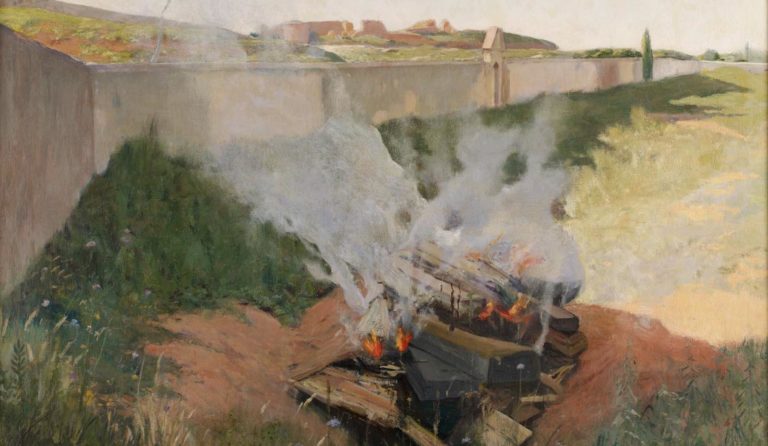
Santiago Rusiñol went to Tarragona in 1894 to visit and keep company with his friend Josep Yxart who was ill at the time. Critic and writer, Yxart had been part of the group of artists and writers of Barcelona’s Cau Ferrat, through Narcís Oller, and who endorsed Rusiñol in the theater and its first premieres. […]
Read moreBust of a lady

Painter, draughtsman and illustrator. Alongside Santiago Rusiñol, he determined the new direction and the move towards artistic modernity in Barcelona. From a wealthy family who liked to travel, in the year 1881 at the age of 15, he went to Paris to study with Charles Auguste Emile-Duran, known as Carolus. Based on the resemblance, this […]
Read moreLandscape
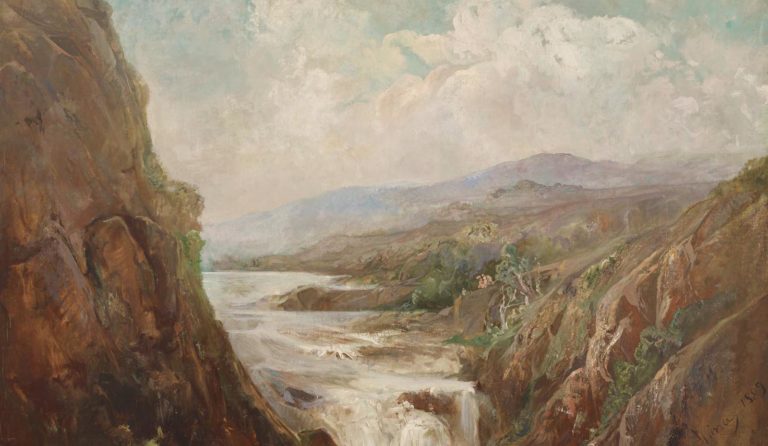
In 1848 he travelled to Paris, where he visited the Louvre and discovered the work of Eugène Delacroix and Gustave Courbet, the greatest international exponent of pictorial realism. In addition to creating, he also undertook important teaching work, following the precepts of French realist painters and the work of the Barbizon school. His innovative teaching […]
Read moreGypsy woman sitting

Nonell painted figures of gypsies until 1907. With a sober, introspective and respectful look, he portrayed an old woman resting; the model was known as Grandma, of gypsy ethnicity. Reluctant to modernist aesthetics, his models were few and far between: Consol, the gypsy who provided him with his “grandmother”, represented in this work, his cousin […]
Read morePortrait of playwright Joaquín Dicenta

Portrait of Joaquin Dicenta is an unsigned and undated work by the artist. The head of the masculine figure stands out against a dark background thanks to a powerful light effect. A virtuoso draughtsman, Ramon Casas manages to convey the vigour and personality of the figure through the expression of his gaze, the modelling and […]
Read moreRosarito

Ramon Casas was interested in women’s fashion and this is reflected in the female portraits throughout his career. Júlia as model and definitive muse in the work of Ramon Casas has been a constant since he met her in 1905, with whom he lived since 1913 and they married in 1922. About 130 representations of […]
Read moreFemale figure

Goldsmith, painter, stage designer and theatre director, he was the most famous member of the Masriera family. Each of the family members undertook a parallel artistic, literary and pictorial activity in their own personal way. The artist is best known for his work as a jeweller and particularly his contributions as an enameller.
Read moreFemale figure
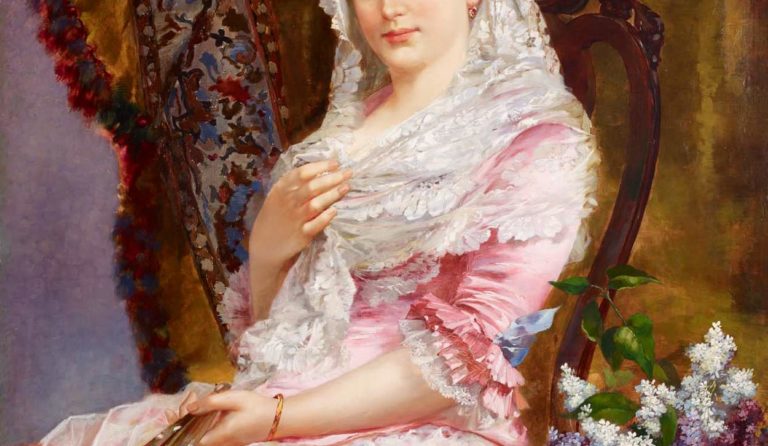
The Masrieras were a family of artists who ran their own goldsmith and jewellery business. They had ties to artistic circles and societies, both in terms of industry and business and culture. They were travellers with an interest in the latest trends. They travelled throughout Europe to the main artistic and cultural events of the […]
Read more